
Finding St. Andrews Residents
Start with the fact that can be checked. For a house or lot, Richland County Property Search can connect an address, owner of record, tax map number, and legal description. For a name, try a court party search, a recorded-land index, a public business or license record, or an old Columbia directory according to the date involved. A St. Andrews result may use Columbia as its mailing city because the CDP has no separate municipal records office. GIS is useful before drawing any conclusion, since it confirms the parcel and its county or municipal setting.
Each source answers a narrow question. A tax roll identifies an owner of record, not every occupant. A deed establishes a recorded transaction, not a current location. A historical directory is a dated publisher entry. Use two independent, dated records before treating a name and address as the same person, especially where names repeat.
- Resolve a current street address through the Assessor or GIS and record the tax map number.
- Compare the owner field, situs, tax mailing address, and legal description without treating them as household evidence.
- Use the ROD index by party name, legal description, or book and page when a recorded land trail matters.
- For a past household, check the Walker Center’s Columbia-area directories, telephone books, obituary index, and maps by publication year.
- Ask the actual custodian for a specific non-exempt record when an online route does not cover the needed time period.
St. Andrews Records Offices
Richland County is the starting jurisdiction for most St. Andrews records. The Assessor maintains the tax-roll view of a parcel, the GIS tools place it on the map, and the Register of Deeds preserves recorded real-estate instruments. The elections office and state voter system follow different access rules. Court and Probate records sit with their respective clerks rather than the county FOIA route. For an address-by-address sequence through these sources, use the St. Andrews street directory route.
Richland County Register of Deeds
1701 Main Street, Room 101
Columbia, SC 29201
803-576-1910
Richland County Assessor
2020 Hampton Street, Suite 2058
Columbia, SC 29204
803-576-2640
Richland County Elections Office
300 Columbia Mall Boulevard, Suite 210
Columbia, SC 29223
803-576-2240
St. Andrews, Columbia, and Richland
St. Andrews is a Census-designated place, not an incorporated city. That fact explains a common search problem. A parcel can be within St. Andrews while the property card, court index, mailing address, or directory uses Columbia and the custodian uses Richland County. Keep all three labels in notes. GIS is the best check for parcel geography, while the Census boundary explains the CDP label and USPS answers an exact delivery question.
These names describe different systems. They should not be swapped freely.
- Parcel or tax map number
- Richland County’s durable property identifier, useful when an address is spelled or labeled differently.
- Situs
- The physical parcel address shown for assessment, which may differ from the tax mailing address.
- Legal description
- The lot, subdivision, plat, or other recorded land description that connects a parcel to deeds.
- ZCTA
- A Census approximation of ZIP service geography, not a USPS delivery boundary or municipal limit.
St. Andrews Property Record Keys
The county-linked Richland Property Search is the practical first check for a current parcel. Its public interface accepts a tax map number, address, or owner. The advanced screen also documents tax district, neighborhood, acreage, construction, size, and transaction ranges, with results sortable by tax map number, address, or owner. It has no dedicated ZIP filter and caps displayed results at 300, so a specific address or parcel is more useful than a broad place name.
| Property-search field | How it works | Why it helps |
|---|---|---|
| Tax Map # | Text or autocomplete | Connects the property card, GIS, and deed research. |
| Address | Text or autocomplete | Finds a parcel when a street and number are known. |
| Owner | Text or autocomplete | Finds an owner-of-record entry, not a full household. |
| Transaction Date | Optional date range | Can narrow a recorded transfer lead. |
The county property-search screen shows the address, owner, and tax-map entry choices used in this St. Andrews residents directory workflow.
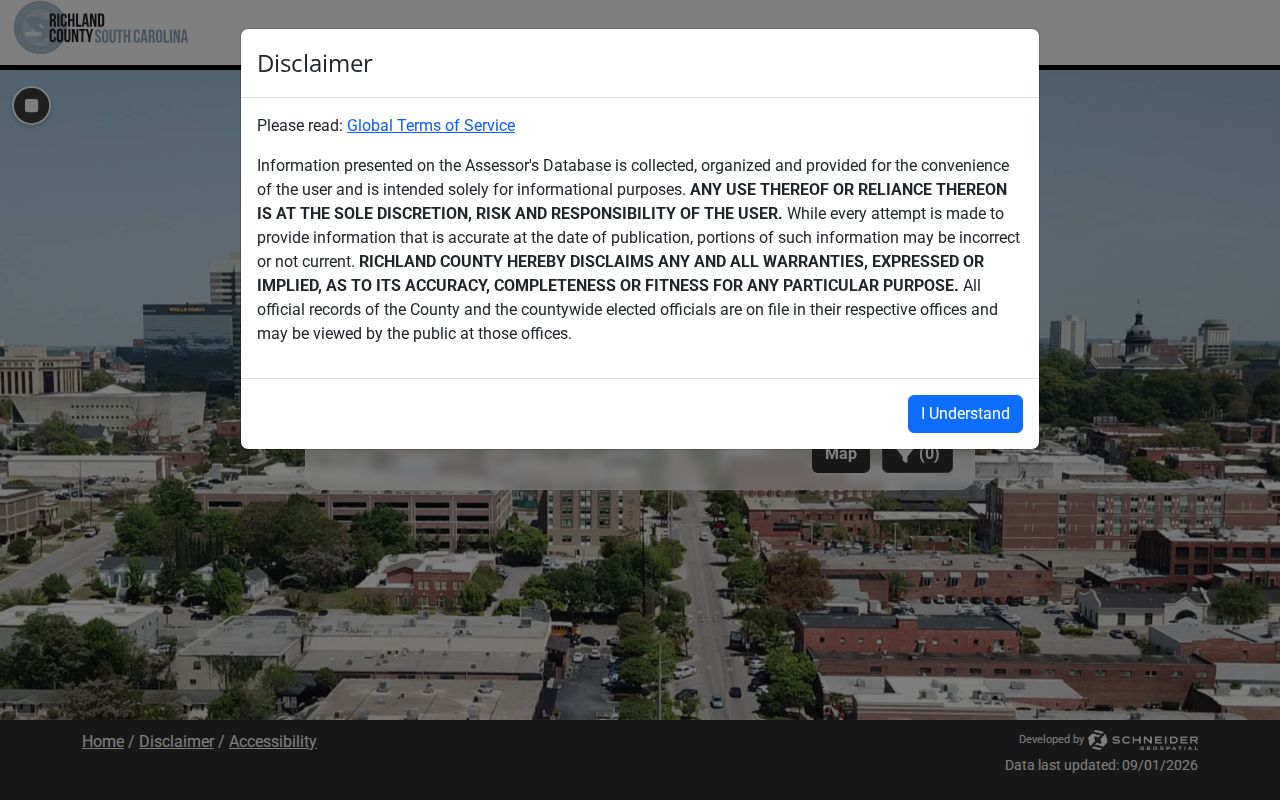
Use the resulting tax map number and legal description as the bridge to mapped parcels and recorded instruments, rather than treating the card as proof of present occupancy.
St. Andrews Deed Access Dates
The Richland County Register of Deeds holds deeds, mortgages, liens, plats, satisfactions, and tax liens. Its online subscription service has two important dates: indexing information begins January 10, 1984, while document images begin February 19, 1998. The paid service offers daily, weekly, monthly, and annual plans. A web miss can mean that an instrument is older, is indexed only by a party or legal description, or lacks an address field.
For a pre-cutoff document, take the owner name, legal description, book and page clues, and date range to the ROD counter at the Richland County Judicial Center. The office says it cannot conduct an open-ended search for a visitor, but staff can explain its own access and copy channels. Treat grantor and grantee roles as dated transaction roles, not current-address confirmations.
Note: An online index entry may exist without an online image because Richland County’s indexing and image dates are different.
Current St. Andrews Resident Sources
There is no official, complete roster of St. Andrews households. Instead, current sources are organized around the role a person has in a record. The property roll is strongest for a current owner of record. Recorded land documents preserve transaction parties. The court index shows public case parties, and voter tools have tightly controlled personal or qualified-purchaser routes. Use the source that matches the question, and retain its date and role when comparing results.
| St. Andrews source | Recorded connection | Custodian | Access route |
|---|---|---|---|
| Property roll | Owner of record, situs, tax map number | Richland County Assessor | Public owner, address, or TMS search |
| Recorded instruments | Grantor, grantee, lien, or plat party | Register of Deeds | Paid web service or counter |
| Public court index | Case party, role, date, and status | South Carolina Judicial Branch | Public index, then the correct clerk |
| Voter services | An individual’s own registration or qualified list fields | State Election Commission | Credentialed lookup or statutory purchase route |
| County history collections | Dated directory, obituary, yearbook, or map clue | Walker Local and Family History Center | Library, digital collection, or research request |
Official records differ from commercial data products in a useful way: the official source identifies the custodian, date, field, and access limit. The tradeoff is that no one public database combines every role. A name that appears in one index deserves a second, independent check. A one-person resident lookup should focus on that verification sequence rather than a broad people list.
St. Andrews Court Name Checks
The South Carolina Judicial Branch public index for Richland is a second, role-based check. After selecting Richland and accepting the notice, a search can use case number, name, action type, date type and range, tax map number, court type, case type, and party role. A result links through a case number or party name and may show the court, case type, party role, filing or disposition dates, status, actions, and a document indicator. Document images are not available for every case.
Start with one or two criteria, then narrow the result. Juvenile, adoption, sealed, expunged, protected Family Court, and certain Probate material may not be public through the index. A known public file belongs with the proper clerk or court, not a county FOIA request.
The Richland Public Index is the court-screen source used for this St. Andrews residents directory record trail.
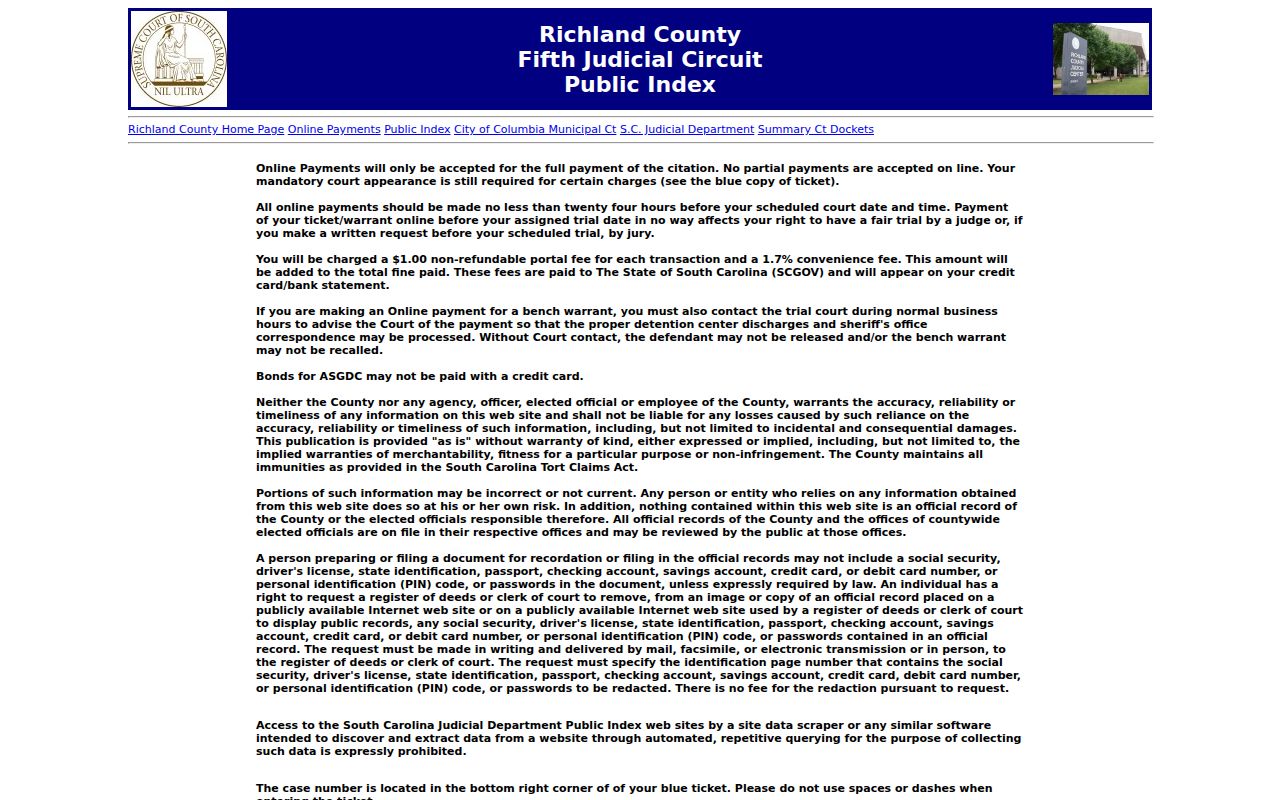
A party name in a docket is evidence of a dated court role. It is not proof that the person now lives at a particular St. Andrews address.
St. Andrews Voter Tool Limits
MySCVotes Voter Information is an identity-verified personal service, not an open name or address browser. It requires the voter’s county, first name, last name, date of birth in month/day/year format, and the last four digits of a Social Security number. South Carolina does not register voters by political party. A record result should be read as the voter’s own registration information, precinct, polling details, and voting-history tools under the state’s terms.
A separate state voter-list channel is available only to registered South Carolina voters. Its authorized filter choices include county, voting district, age, sex, race, household, registration date, and election participation. The State Election Commission describes the file fields and fees, but ballot choices are never part of the list. State law restricts commercial solicitation using qualifying public-record personal information.
The MySCVotes sign-in screen makes the credential requirement visible before any personal record is reached.
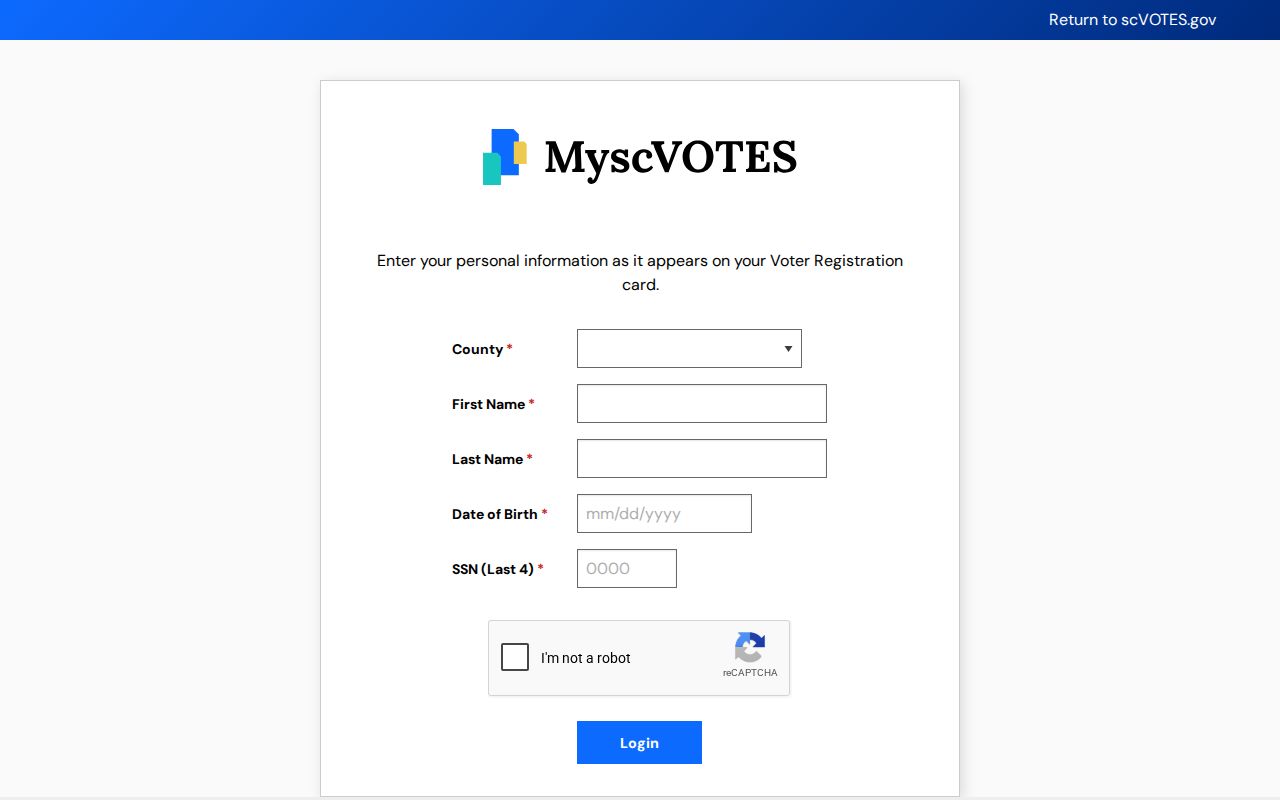
When a custodian question remains, the Richland County Board of Voter Registration & Elections can explain its own local registration and election channels.
St. Andrews FOIA Record Requests
When a county portal does not hold a known non-exempt record, a focused written request under the South Carolina Freedom of Information Act is the documented fallback. Identify the actual Richland County custodian, record type, narrow date span, and any parcel or case reference. The law calls for a determination within 10 business days, or 20 business days for records more than 24 months old. If granted, production is due within 30 or 35 calendar days, subject to a lawful deposit and exemptions.
Richland County uses the actual or pro-rated gross hourly rate of the lowest-paid qualified employee for permissible search, retrieval, copying, and redaction work. Its stated schedule also includes a $25 off-site retrieval charge and a possible deposit up to 25 percent of anticipated reproduction cost. A request does not require an agency to create a new identity report, and it cannot override court, vital-record, or address-confidentiality protections.
The Richland County public-records page is the source for the local request procedure and current fee approach.
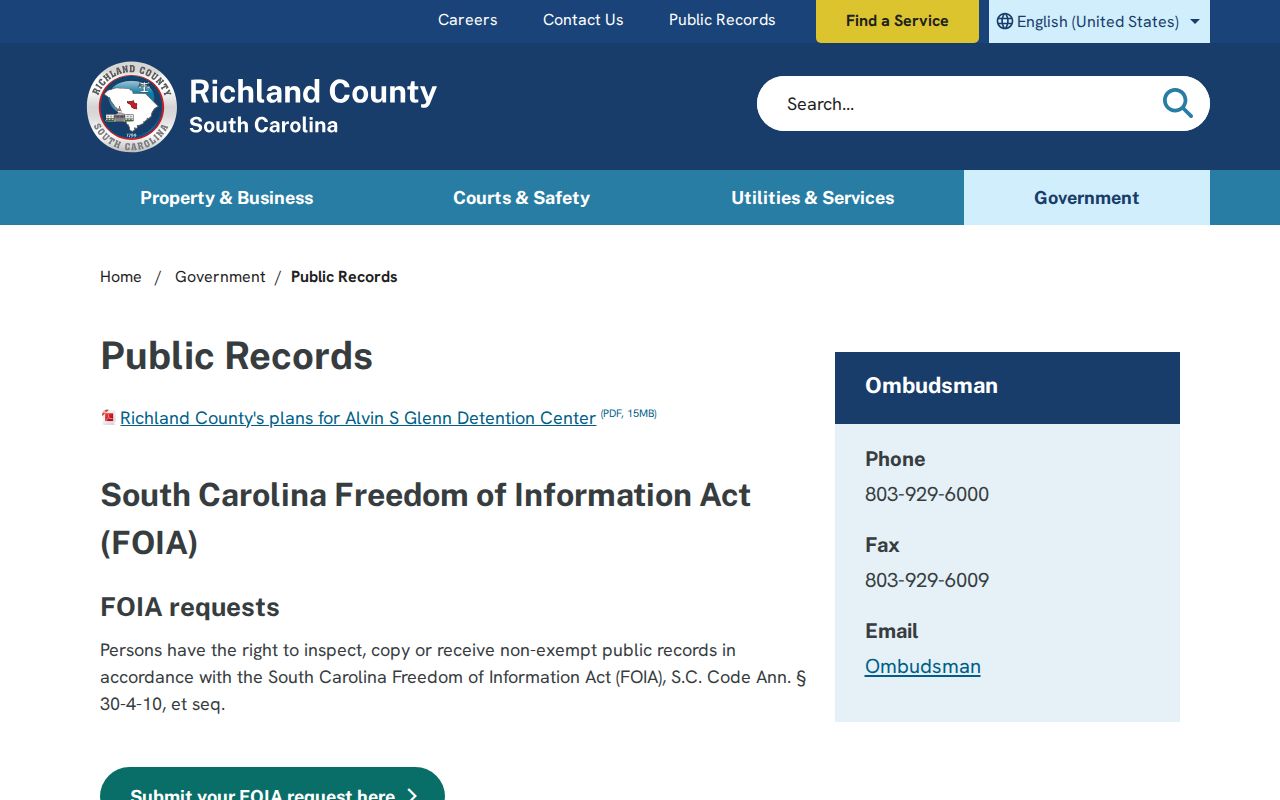
Pinning a request to an existing record and the right office makes the response more useful than asking for a broad list of people.
Historical St. Andrews Resident Directories
Historic St. Andrews research uses Columbia and Richland County collections because the CDP has no separate historic municipal shelf. The University of South Carolina’s digitized Columbia city-directory collection supplies searchable but non-annual volumes from 1859 through 1927. Richland Library holds Hill’s Columbia directories in cataloged 1929–1979 runs with gaps and later Polk volumes from 1985–1997 with gaps. A reverse or criss-cross department can begin with an address, while the name department can add occupation, spouse notation, and residence language.
Every listing is a date-stamped publisher clue. Preserve the printed spelling, street number, page, and year, then test the lead against a directory from another year, a released census schedule, a deed date, a telephone book, map, Probate file, or obituary citation. The full collection-by-collection method is on the St. Andrews historical directory page.
Walker Center St. Andrews History
The Walker Local and Family History Center is the local fallback when the current county indexes stop short of an older household question. Its collection scope expressly includes Columbia, Richland County, and the county’s CDPs and unincorporated areas. The Center provides city directories, local-history and obituary indexes, maps, area school yearbooks, FamilySearch Affiliate access, and walk-in or appointment research. Its remote obituary request process asks for a name, date or range, residence, and requester email, and it limits requests to three each week.
A library index result often points to a newspaper citation or shelf item rather than a full image. That is still useful. Record the source title, date, page, and collection name before asking for a copy or pairing it with a government record. For statewide pre-digital material, the South Carolina Department of Archives and History is the next historical route.
The library channel adds time and publication context to an address trail without turning a historical entry into a current resident claim. Search “St. Andrews,” “Saint Andrews,” “St Andrews,” the street name, Columbia, and Richland County because collection metadata can use different labels. For older material, preserve the catalog citation and access condition before requesting a scan, copy, or staff assistance.
Protected St. Andrews Records
South Carolina access rules leave important gaps on purpose. Certified vital records have relationship and time restrictions under S.C. Code Ann. § 44-63-80. Courts can restrict sealed, expunged, juvenile, adoption, and confidential case material. The Attorney General’s Address Confidentiality Program gives qualifying participants a substitute address that agencies and courts must accept. A missing address may reflect a lawful protection rather than an error in a search screen.
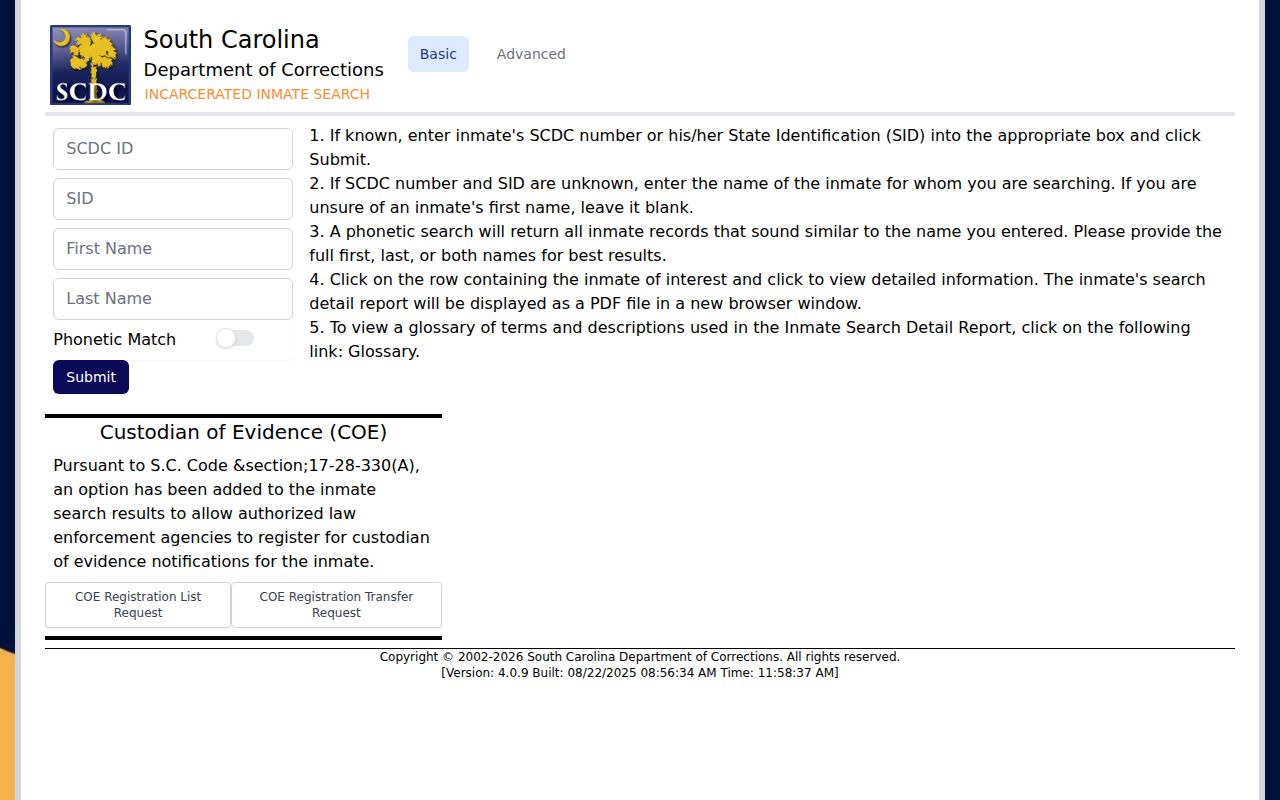
Some databases are also status-specific. The South Carolina Department of Corrections inmate search covers current SCDC custody as of the prior midnight, but excludes county detention, released people, community supervision, juveniles, fugitives, and federal custody. It accepts SCDC ID, SID, first or last name, and a phonetic option, with additional filters and a 250-result cap.
The SCDC public search is included here only to show its state-custody scope and terms.
Use records for lawful personal, family-history, estate, civic, or safety purposes, and never to stalk, harass, threaten, or harm another person. When details conflict, return to the custodian’s current index or ask which field, date, or restriction controls the record at issue. Keep a note of that answer beside the source URL so a later search does not turn an old result into a fact.
Privacy boundary. A parcel owner, recorded party, or database result does not reveal every person at an address, and protected information must remain protected.